


Your website is more than just a digital brochure; it is a physical map that guides two completely different types of visitors. To convert casual web surfers into paying clients and to ensure AI platforms recommend your business, your website must be organized with absolute clarity.
Building a great website structure means grouping related topics together so that no page is ever more than a few clicks away. When your layout makes intuitive sense, real people find answers instantly, and AI engines can instantly verify your business as an industry authority.
What is Website Architecture?
Website architecture is the organizational framework that dictates how the pages on your site are connected, grouped, and presented to your audience. Think of it as the architectural blueprint of a house, where your homepage is the front door, and your service categories are the main hallways leading to specific rooms.
A well-designed structure ensures that a visitor can land on any page and immediately understand where they are and how to take the next step. It eliminates confusion by removing dead ends, cluttered menus, and disorganized links that cause potential clients to leave your site out of frustration.
The Dual Audience: Designing for Humans vs. AI Bots
You are no longer designing websites just for human eyes; you are actively building them to be read by artificial intelligence and search engine crawlers. Human visitors navigate using visual cues, emotions, and instant gratification, while AI bots look for logical patterns, clear data hierarchies, and contextual relationships between pages.

- Human Needs: Real people want to find what they are looking for in under three seconds with minimal thinking. They rely heavily on clean menus, prominent buttons, and clickable paths that feel entirely natural.
- AI Bot Needs: Modern search engines and AI assistants need to understand the exact context of your business to recommend you. They crawl your site by following links, calculating how closely related your pages are, and building a cognitive map of your expertise.
Balancing both audiences means creating a beautiful, simple front-end experience for your clients that is backed by a perfectly organized, highly logical back-end structure.
Flat vs. Deep Architecture: Finding the Sweet Spot
A flat website architecture is vastly superior for business websites because it ensures that any page can be reached in three clicks or fewer from the homepage. Deep architectures bury valuable information under endless layers of subfolders, which frustrates users and causes search engine bots to stop exploring your site before they find your core services.
- The Flat Approach (Highly Recommended): In a flat structure, your home page links directly to your main category pages, and those categories link directly to your individual services or articles. This layout spreads your site’s authority evenly and guarantees that neither humans nor AI bots have to hunt for hidden details.
- The Deep Approach (To Be Avoided): A deep structure forces users to click through subcategory after subcategory to find what they need. This setup dilutes the visual importance of your pages and signals to AI platforms that your buried content is minor or irrelevant.
To achieve an optimal flat structure, focus on a clean, horizontal expansion of your topics rather than building deep vertical stacks of submenus.
The Silo Structure: The Secret to Topical Authority
Organizing your website content into thematic “silos” is the most effective way to prove your business expertise to AI search tools while keeping users deeply engaged. A silo structure (frequently called the hub-and-spoke model) groups all related content under one overarching primary topic, preventing unrelated services from cluttering each other.
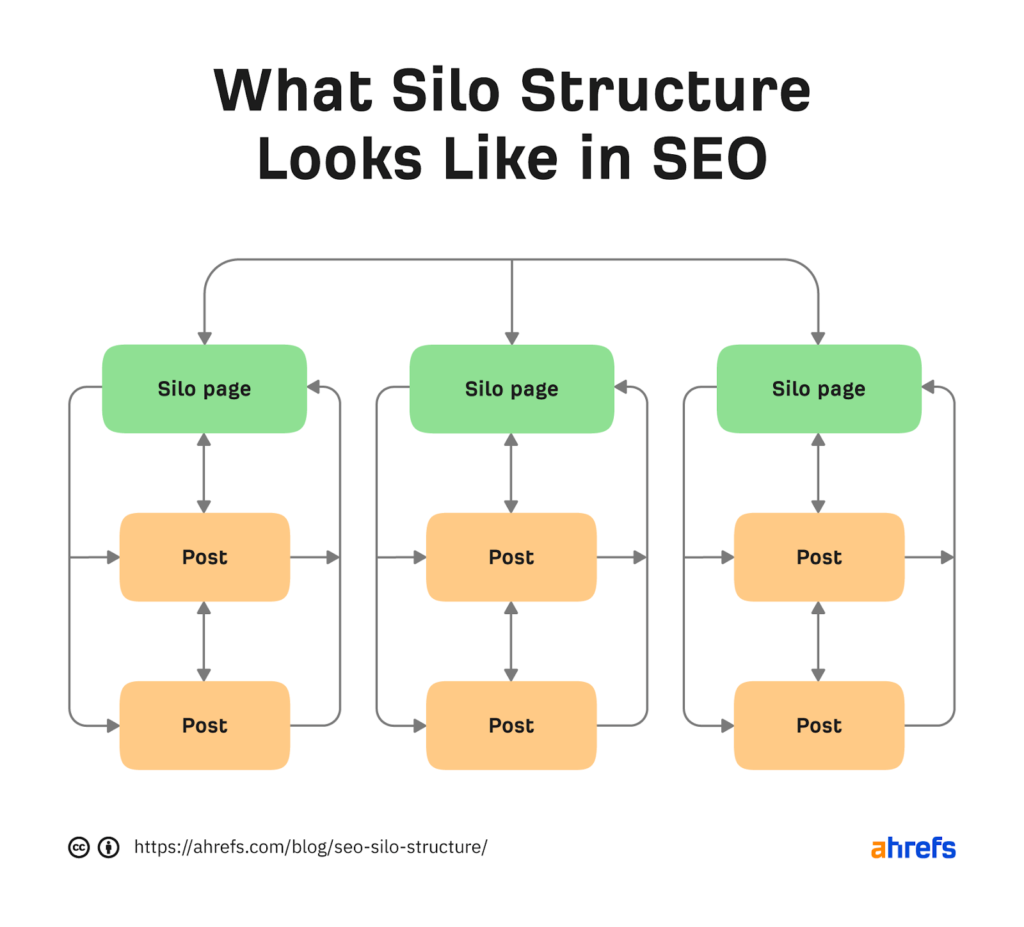
- The Core Hub Page: This serves as your main pillar page for a specific service or category. It provides a comprehensive, high-level overview of the topic and establishes your main message.
- The Spoke Pages: These are supporting articles, case studies, or localized service pages that dive deep into specific details or subtopics.
- Strict Interlinking: Spoke pages must link directly back up to the main hub page and link horizontally to each other within the same silo. They should rarely link to pages in completely different silos, as this breaks the thematic clarity that AI bots look for.
For instance, if your business offers digital marketing, your “Social Media Marketing” hub should link exclusively to subpages about Instagram tips, LinkedIn strategy, and Facebook ads. Keeping these pieces grouped tightly together tells AI search engines exactly where your expertise lies.
URL Structuring: Simple, Clean, and Descriptive
Your website’s web addresses should be simple, lowercase, and instantly readable by an everyday user without any random numbers or technical codes. A clean link serves as a literal breadcrumb trail that tells both humans and AI bots exactly where they are sitting inside your site’s architecture.
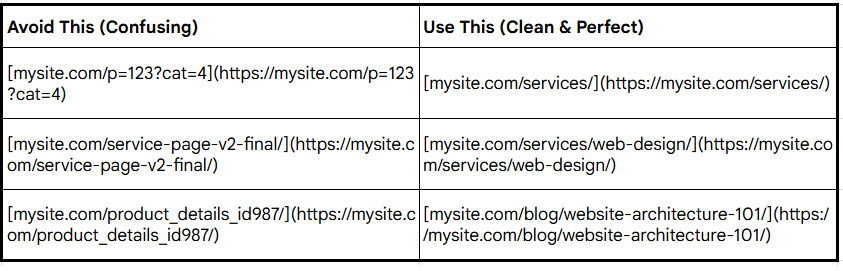
When writing URLs, always separate words with simple hyphens rather than underscores or blank spaces. Keep the path short, omit unnecessary words like “the” or “and,” and ensure the URL directly reflects the title of the page to build instant trust before a user even clicks.
Internal Linking: Building Navigational Highways
Internal links are the clickable pathways within your body text that connect one page of your website to another, distributing value and keeping visitors browsing longer. Without a strong network of internal links, your pages exist as isolated islands that AI bots cannot discover and users cannot navigate to naturally.
- Use Descriptive Text for Links: Avoid using generic phrases like “click here” or “read more” for your clickable links. Instead, embed the link into natural phrases like “explore our web design services” so AI systems understand the exact topic of the destination page.
- Pass Around Authority Responsibly: Your homepage inherently holds the most brand power. By linking directly from your homepage to your core service hubs, you share that authority and help those important business pages rank higher in modern search results.
- Fix Broken Connections: Routinely check your site to ensure all links function correctly. A broken link creates an immediate roadblock that damages user experience and causes AI engines to flag your site as poorly maintained.
Interactive Architecture Planner
Experiment with the layout builder below to visualize how a flat, cleanly organized business website flows from the homepage down to individual service pages.
Practical Checklist for Your Business Site
A flawless layout relies entirely on keeping things simple, logical, and thoroughly organized from day one. Use this direct checklist to assess your current website setup and identify quick areas for structural improvement:
- The Three-Click Maximum: Ensure that a user can navigate from your homepage to your most deeply hidden service page in three mouse clicks or fewer.
- Zero Orphan Pages: Verify that every single page on your website is linked to by at least one other page so search engines can easily find it.
- Mobile-Friendly Menus: Simplify your top header navigation bar so it scales beautifully on mobile phones without creating massive, cluttered lists.
- Descriptive Link Text: Replace unhelpful “click here” text links with highly descriptive phrases that explain the actual destination.
- One URL Version: Set up your website security so that all variations of your domain redirect smoothly to a single, secure web address.
Taking the Next Step
Fixing your website’s architecture is the single most sustainable update you can make to improve customer conversion rates and boost your overall visibility across AI engines. However, an organized layout only succeeds if it performs flawlessly on smartphones and mobile devices. Once you clean up your page structure, check out our mobile-first indexing and website speed SEO guide to ensure your fast-loading pages match your smart new design. By grouping your core services cleanly and keeping your links easy to navigate, you turn your website into an inviting digital storefront built to thrive in the modern web era.