


Table of Contents
ToggleIntroduction: Navigating the Technical SEO Software Landscape
Managing a website’s overall structural health can often feel like chasing invisible problems. Hidden infrastructure issues like rendering bottlenecks, indexation bloat, and broken internal architecture silently drain your organic revenue while wasting precious search engine crawl budgets. If your site’s underlying technical foundation is fractured, even the most exceptional content marketing strategy won’t keep you visible.
This reality leaves digital marketers facing a frustrating software dilemma when selecting their primary Technical SEO Tools. Choosing the right crawler means constantly balancing your computer’s local hardware limits against expensive cloud server subscriptions and genuinely actionable data reporting. It is incredibly easy to get bogged down by messy, raw data dumps or find yourself restricted by tight page-credit usage boundaries.
To help you cut through the search engine optimization noise, this guide serves as the definitive look. We will evaluate these major players based on operational ROI, overall scalability, and their best real-world use cases. When weighing your options, the classic debate often comes down to Screaming Frog vs Ahrefs, but adding a specialized tool like sitebulb to the mix completely changes the equation.
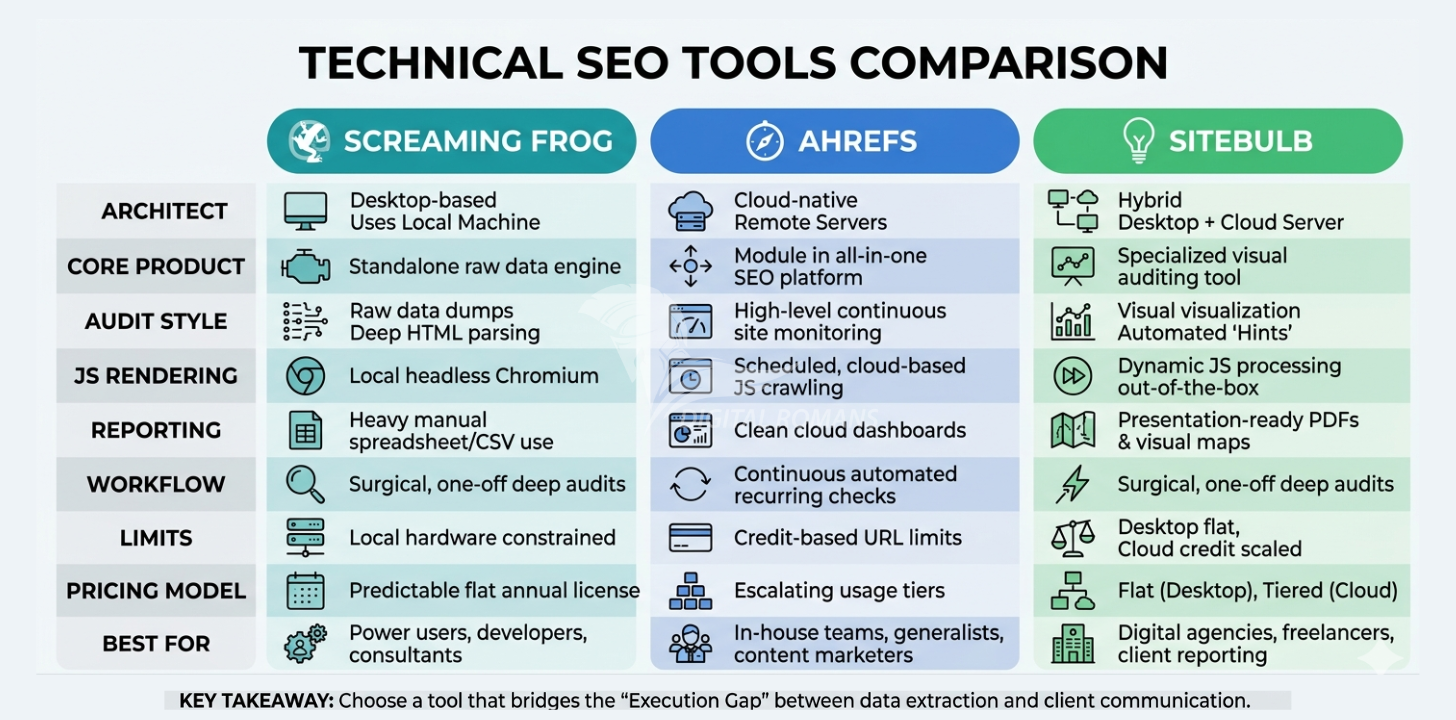
Before we dive into the deep architecture under the hood, here is a quick look at how these prominent platforms stack up against one another:
- Screaming Frog: A local machine-based raw data engine built for advanced data extraction, custom scraping, and deep technical parsing with no crawl credit limits.
- Ahrefs: A cloud-native, all-in-one platform module ideal for hands-off, continuous site monitoring linked directly to keyword and backlink tracking databases.
- Sitebulb: A visualization-heavy hybrid tool that automatically translates complex code issues into prioritized, client-ready advisory items and crawl maps.
Architectural Differences: Desktop vs. Cloud vs. Platform
Before comparing specific site auditing features, it is vital to understand how these programs process data under the hood. Technical optimization platforms generally fall into three distinct categories: desktop software, cloud-native crawlers, and all-in-one suite modules. The underlying framework you choose dictates everything from your daily crawl speed to how much your monthly subscription costs will scale.
Desktop Crawlers: Local Hardware Dependency
Desktop crawlers run directly on your personal computer, utilizing your local machine’s RAM and processor to scan web pages. The major benefit here is cost efficiency, as these setups typically offer flat-rate annual licenses for unlimited crawling without charging per-page usage fees. However, you are entirely limited by your computer’s hardware, meaning massive enterprise site audits can slow down your device or freeze your operating system.
Cloud-Native Crawlers: Remote Server Scale
Cloud crawlers remove the technical strain from your local laptop by offloading all data processing to remote, dedicated web servers. This allows you to execute massive enterprise crawls, share data with remote team members in real time, and schedule automated recurring monitoring checks hands-off. Because the intense processing occurs in the cloud, your personal computer stays fast and functional regardless of the site’s size.
All-in-One SEO Platforms: Unified Suites
All-in-one platforms take a much broader marketing approach by bundling site auditing inside a massive suite of varied organic tools. In these ecosystems, technical health checkups exist as a specialized feature running alongside keyword tracking, competitor analysis, and backlink research databases. While this provides great high-level convenience for multi-tasking marketers, these modules can occasionally lack the hyper-specific configuration adjustments found in standalone crawlers.
Screaming Frog SEO Spider: The Unrivaled Raw Data Engine
Screaming Frog is the definitive desktop crawler and a long-standing industry standard beloved by technical SEO purists. It remains the ideal software for deeply technical marketers, developers, and solo consultants auditing websites under 50,000 URLs who demand absolute control over raw HTML data parsing.
When comparing Screaming Frog vs Ahrefs and sitebulb as essential Technical SEO Tools, the Frog exhibits distinct functional differences:
- Custom Extraction Power: Unlike cloud alternatives, it offers unmatched superiority in scraping specific on-page elements, metadata, and complex structured data payloads using XPath or Regex.
- Localized Aggregation: It seamlessly pulls in real-time metrics from Google Analytics, Google Search Console, and PageSpeed Insights directly into a single local interface.
However, this raw processing engine brings specific scalability constraints.
Because it runs locally, running massive e-commerce audits causes severe hardware bottlenecks, easily crashing standard laptops without high-RAM setups or database storage modifications. Furthermore, its raw data-dump layout creates “CSV workflow” friction, forcing users to spend hours manually cleaning spreadsheets to bridge the client communication gap.
Sitebulb: The Actionable Hybrid Auditor
Sitebulb bridges the gap between raw data and client communication by offering an award-winning hybrid of a local desktop application and a powerful cloud server version. It is perfect for digital agencies, freelance SEOs, and managers who need to translate complex structural problems into stakeholder-friendly presentations.
The bulleted list below highlights the key differences between The Best Technical SEO Tools Compared: Screaming Frog vs. Ahrefs vs. Sitebulb:
- Screaming Frog focuses on raw data dumps and local hardware processing, whereas sitebulb automatically interprets issues using a prioritized “Hints” engine.
- Ahrefs uses a cloud-native platform module for high-level monitoring, while Sitebulb provides interactive visual crawl maps to diagnose site structure intuitively.
- Sitebulb overcomes local machine memory limits via cloud scaling, but plans scale up in cost based on monthly URL limits (e.g., 1 million to 5+ million URLs).
Navigating this landscape means balancing raw computing power against data presentation. Ultimately, the classic Screaming Frog vs Ahrefs dilemma shifts dramatically when you prioritize the visual actionability offered by specialized Technical SEO Tools.
Choosing the right Technical SEO Tools often comes down to balancing raw crawling power with day-to-day data actionability. This definitive Screaming Frog vs Ahrefs and sitebulb breakdown cuts through the marketing noise to analyze actual ROI, scalability, and everyday workflows.
- Screaming Frog: Desktop powerhouse built for granular custom extractions and massive site crawls.
- Ahrefs: Cloud-based suite combining automated site monitoring with elite backlink equity metrics.
- Sitebulb: Visual auditor that translates dense technical errors into clean, ready-made client reports.
Ahrefs Site Audit: The All-in-One Ecosystem
Ahrefs’ Site Audit tool operates as a cloud-based powerhouse nested within its industry-leading SEO platform. It is ideal for in-house marketing teams and generalists who want their technical, on-page, and off-page data housed in a single subscription.
Its standout features include automated cloud monitoring for hands-off, recurring weekly or monthly health checks. Marketers gain seamless ecosystem integration by cross-referencing broken internal links directly with external backlink equity to salvage lost link juice.
However, scalability constraints remain a hurdle. Credit-based pricing means massive site migrations quickly burn through monthly URL limits, triggering expensive plan upgrades. Furthermore, it lacks the hyper-specific XPath extraction and custom parameter controls offered by standalone engines.
Choosing the right software can completely redefine your performance. This guide serves as the definitive Best Technical SEO Tools Compared: Screaming Frog vs. Ahrefs vs. Sitebulb analysis, focusing on ROI, scalability, and specific use cases. Selecting the right Technical SEO Tools means balancing deep data with executive-level reporting efficiency.
Feature Head-to-Head: Which Tool Wins Where?
When deciding between Screaming Frog vs Ahrefs or integrating sitebulb, your unique system constraints dictate the perfect fit.
Here are the key differences highlighting The Best Technical SEO Tools Compared:
Screaming Frog vs. Ahrefs vs. Sitebulb:
- JavaScript Rendering: Screaming Frog runs a powerful local headless Chromium setup. sitebulb handles dynamic JS processing right out of the box, while Ahrefs utilizes scheduled, cloud-based JS crawling.
- Client Reporting: sitebulb shines with presentation-ready PDFs. Conversely, Ahrefs provides clean, high-level dashboards, while Screaming Frog relies heavily on manual spreadsheet manipulation.
- Audit Style: Screaming Frog and Sitebulb Desktop excel at surgical, one-off audits. For continuous, automated monitoring, Ahrefs and Sitebulb Cloud provide seamless ongoing oversight.
Financial Analysis: Maximizing Your Software ROI
When investing in Technical SEO Tools, pricing structures drastically affect your margins. Desktop choices like Screaming Frog and sitebulb offer predictable, flat annual licensing with unlimited crawls. Conversely, platform ecosystems like Ahrefs or Sitebulb Cloud rely on escalating tier limits that can spike software expenses as your client roster scales.
Yet, a cheaper sticker price doesn’t guarantee the best return on investment when evaluating Screaming Frog vs Ahrefs. A massive “execution gap” can emerge if your team spends profitable billable hours cleaning sheets and explaining raw datasets to clients. While Screaming Frog saves money upfront, it frequently drains manual labor hours compared to Sitebulb’s instant, presentation-ready visual reports.
Conclusion: Final Recommendations for Your Tech Stack
When optimizing your suite of Technical SEO Tools, match the software to your operational bottlenecks. If you are a solo consultant or an enterprise developer needing deep code-level scraping, choose Screaming Frog. For digital marketing agencies scaling client reporting without manual spreadsheet work, sitebulb is the superior, visual choice. Meanwhile, cross-functional teams prioritizing broader content analytics and cloud automation will find the choice between Screaming Frog vs Ahrefs heavily favoring the latter.
Before locking into a monthly subscription, audit your actual workflows. Review your local hardware capabilities, team collaboration needs, and budget constraints to choose a platform that yields maximum long-term value.