



In the past, when your website traffic suddenly went down, the reason was usually something on your site — slow page speed, weak content, a wrong robots.txt setting, or not adjusting after a Google update. These issues often caused lower rankings.
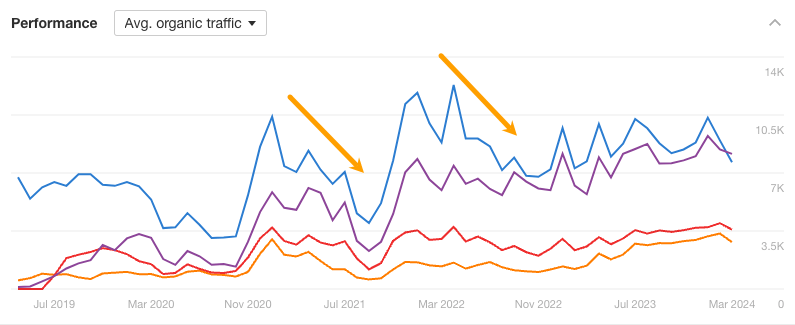
But today, a drop in traffic usually means something different: fewer people are clicking on your site from Google’s organic search results. And this isn’t just happening to you — businesses everywhere are seeing the same trend.
The main reason? Artificial intelligence (AI).
With Google’s new features like AI Overviews and AI Mode, people get direct answers right on the first page. Since the information is already summarized for them, users don’t feel the need to click on the usual “10 blue links.”
In this blog, we explain why declining traffic isn’t your fault — and why it’s time to start optimizing your content for AI Overviews and AI Mode instead of relying only on traditional organic search.
Let’s Reintroduce Google AI Overviews and AI Mode
If you’ve kept up with Google’s search updates this past year, you’ve likely heard about AI Overviews, the Search Generative Experience and, more recently, AI Mode. These features are changing how billions of people use Google Search.
So, what are they?
Google AI Overviews
AI Overviews are short summaries that appear at the very top of many search results pages. They use Google’s generative AI to give users fast, combined answers from different sources — often without needing to click on any website.
Ronnel Viloria, Lead SEO Strategist at Digital Marketing Agency, explains it clearly:
“When AI Overviews show up at the top, users usually don’t scroll. If your content is included in the overview, that’s great. If not, you’re stuck competing with everything below it.”
When someone uses AI Mode, Google shows them:
• A short paragraph that answers their question
• Extra details pulled from different websites
• A few clickable links to the sources
Because of this, SEO has expanded into a new area called AI SEO or Generative Engine Optimization (GEO).
In simple terms, businesses now need to optimize their content not just for traditional search engines, but also for AI-powered platforms like ChatGPT, Perplexity, Gemini, Copilot and Google’s AI Overviews.
GEO helps websites become visible within these AI-generated answers and summaries.
Google AI Mode
Google first introduced AI Mode in March, and at that time, only U.S. users could try it through Search Labs. Now, everyone can use it without opting in. When AI Mode is turned on, it completely changes how the search results page looks.
Instead of seeing the usual list of website links, users see a conversational, AI-generated answer at the top — similar to a ChatGPT-style summary. In many cases, this AI response takes up most of the screen, pushing regular search results (including your website) much lower on the page or even out of view at first glance.
How These AI Features Are Eating Away at Your Website Traffic
Here’s where things get real.
With AI Overviews and AI Mode, Google is trying to answer user questions before they click on any website. This creates a big problem for businesses:
- Your detailed blog post might get reduced to a short summary — sometimes without even giving you a proper link.
- Your product or service could be mentioned, but users may never visit your site.
- Your brand might appear on the screen, but you don’t get actual traffic from it.
This drop in website visits is happening because of zero-click searches, where users get everything they need directly on Google. The more people rely on these AI summaries, the fewer visitors reach your website.
If you’re wondering, “Why is my website traffic going down?” A quick way to check if Google is the reason is to compare your traffic with your competitors in Google Analytics. If you notice that everyone’s traffic drops around the same time, that’s a strong sign that Google’s new AI features are taking clicks away from your entire industry, not just you.
Why Is Website Traffic Down Worldwide?
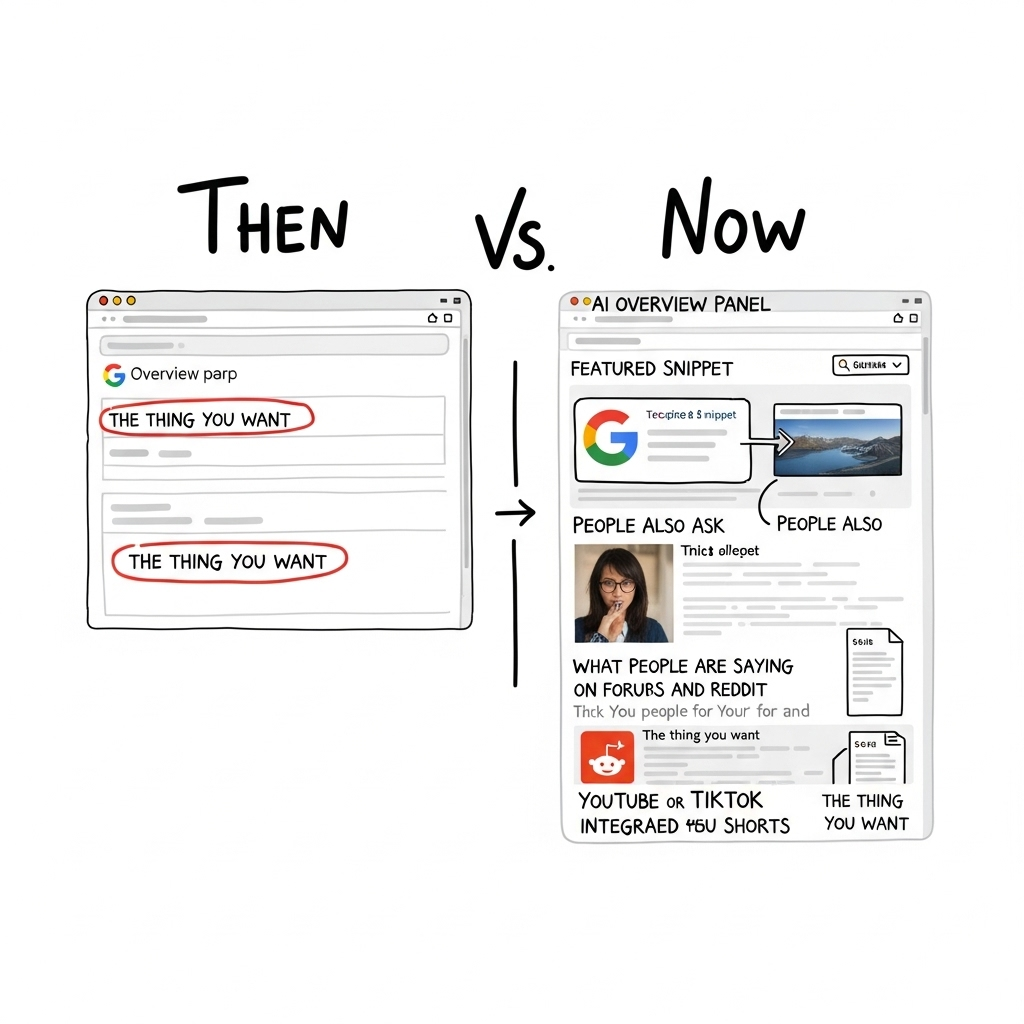
There was a time when being ranked #1 on Google meant your website appeared clearly at the top of the page. For example, back in 2019, if someone searched for “best ecommerce agency in the US,” the search results looked much simpler:
- One sponsored ad at the top
- A small “People Also Ask” section
- The #1 organic result — your website — shown clearly and easy to find
- Then the remaining organic results (#2–#10)
- Sometimes a few extra features like review stars or site links
This clean layout gave your site strong visibility, a good click-through rate (CTR) and consistent website traffic.
But today, searching for the same keyword looks completely different — and much more crowded. That’s why worldwide traffic is dropping, even for top-ranking websites.
Google SERP in 2025 (Same Informational Query)
Today, when you search for the same type of informational query, the Google results page looks very different. A typical 2025 SERP now includes:
- An AI Overview panel at the very top, summarizing the main answer
- A Featured Snippet from a website (and it may not be yours)
- A larger People Also Ask section with many expandable questions
- A What People Are Saying area with quotes from forums or Reddit
- A Discussions & Forums section showing Reddit, Quora and community posts
- Video results from YouTube or TikTok
- And finally… the #1 organic result, pushed far down the screen
Because of these new layers, even if your ranking hasn’t changed, your visibility and CTR drop sharply. This naturally leads to lower website traffic.
The image below shows a clear comparison of how SERPs used to look versus how they look today.
Same Rank, Less Reward: The Hidden Cost of SERP Expansion
Even if your website still ranks No. 1, it no longer gets the same attention. Your listing is now pushed down by many new SERP features. What used to appear occasionally is now a standard part of almost every search page.
This is why many businesses are seeing traffic drop even though their rankings haven’t changed — users simply don’t need to click anymore. Google gives them the answer right on the search results page.
“As Viloria explained, ranking is no longer the end goal — it’s only the beginning. Your content must appear across AI-generated results to stay visible.”
Research from platforms like Search Engine Land shows that over 60% of searches now end without a click. This is the new reality of a zero-click search world.
Where AI Overviews Show Up — And Where They Don’t
To understand why some pages lose more traffic than others, it helps to know which types of searches trigger an AI Overview (AIO).
A study from December 2024 that analyzed 10,000 U.S. keywords across seven industries gives us a clear understanding of this.
What the data says
Why it matters
AI Overviews appear for only 29.9% of keywords, which covers 11.5% of all searches. They don’t show up everywhere, but when they do, they take the top spot on the results page above the normal search results.
Even though AI Overviews don’t appear all the time, they can still take a big chunk of your visibility because they show up at the very top of the search results.
Medium-volume keywords (around 501–2,400 searches per month) show AI Overviews the most — 42% of the time. Very high-volume keywords are less likely to show them.
Pages that target long-tail or mid-length “how-to” or comparison keywords are most likely to lose traffic to these AI summaries.
Different industries also see different results. Telecom keywords triggered AI Overviews 56% of the time, while Beauty & Cosmetics keywords showed them only 14% of the time.
Industries with complex, research-heavy topics (like tech, B2B SaaS, and telecom) are more likely to have their content summarized by AI. Lifestyle topics are affected less — at least for now.
Search intent is even more important. Problem-solving searches show an AI Overview 74% of the time, and direct question searches show one 69% of the time. Searches where people are trying to go to a specific website almost never show an AI Overview.
FAQ pages, troubleshooting guides, and “how do I…” articles are the most likely to be replaced by AI answers. But your branded homepage traffic is usually not affected.
Non-brand keywords show AI Overviews 33% of the time, compared to 19.6% for brand keywords.
Content aimed at people early in their research journey is more likely to be condensed into an AI Overview. Meanwhile, brand-focused searches at the bottom of the funnel still tend to get regular clicks.
Key Takeaway for Marketers
If you notice a sudden drop in organic traffic, it’s not always because Google changed its algorithm. Your traffic isn’t disappearing completely. Instead, review your content and find which parts target mid-volume, question-based, non-brand keywords — these are the ones most likely losing clicks to AI Overviews.
After identifying them, focus on:
- Strong answers: Create clear, well-structured answers so your content has a better chance of being cited inside the AI Overview.
- Brand presence: Build a memorable and consistent brand so people think of you even if they don’t click your link.
- Better user experience: Add tools, calculators, or visuals that AI summaries cannot easily copy.
“We need to make content easy to scan, factual, and instantly helpful for AI-driven formats,” Viloria said.
By understanding where Google’s AI is most active, you can protect your traffic while still benefiting from being referenced inside the AI Overview.
It’s Not Just About Traffic Anymore — It’s About Being Seen
A sudden drop in website traffic can feel worrying, but less traffic doesn’t always mean your website is losing value. Traffic alone is no longer the only way to measure success.
Search is changing — and so should how we look at it.
Today, with AI helping in search, people can find, trust, and remember your brand even without clicking on your site. Tools like AI Overviews and AI Mode give users quick, reliable answers. To do this, Google uses content from websites it thinks are trustworthy, helpful, and accurate.
This means that if your content is:
- Quoted in AI-generated summaries,
- Linked as a source under AI answers, or
- Shown in featured snippets or knowledge panels,
…you are still part of the conversation. Your content is being seen — just in a new way.
Visibility = Influence
Today, it’s not just about ranking high or getting clicks. The real goal is to be seen where decisions are made, even if people don’t visit your site right away.
Your brand can appear in places like:
- A paragraph in an AI Overview
- A suggested product carousel
- A “People Also Ask” answer
- A local pack or knowledge panel
These spots give high visibility, shape how people see your brand, and often influence their future choices.
At Digital Romans , we don’t just talk about AI-focused SEO — we prove it with results. Between Q1 and Q2 of 2025, we boosted our referral traffic from AI platforms by 2,219% thanks to our hands-on approach to generative engine optimization (GEO). Here’s the breakdown:
- +117% referral traffic from Gemini
- +119% growth from ChatGPT-based search
These results didn’t happen by luck. Digital Romans’s AI SEO services include:
- Crafting and testing prompts in real time across AI platforms
- Optimizing passages, using semantic SEO, schema markup, and targeting conversational queries
- Creating content that AI can understand, trust, and cite in its summaries
In short, Digital Romans helps brands appear where decisions are being made — inside AI-generated answers — so you stay visible even when users don’t click. And our growth in AI-driven referrals shows that this approach works.
If you want to keep up with Google’s latest updates and optimize your website for both traditional search and AI-powered search, Digital Romans is the agency to help you.