

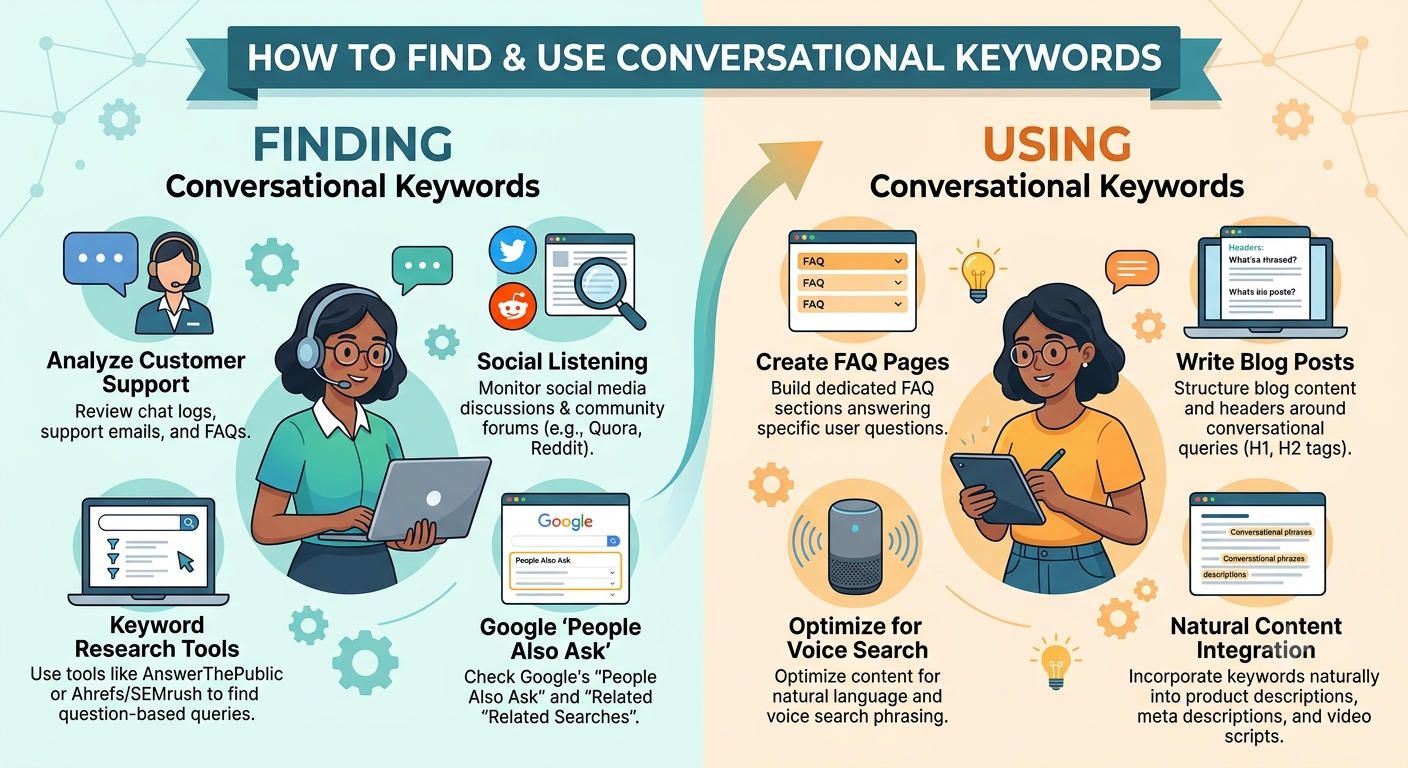

Voice search keyword research requires shifting from fragmented two-word head terms to natural-language phrases that mirror how people speak to AI assistants and smart devices. Traditional search optimizations prioritize high-volume queries like “best digital marketing agency,” whereas voice queries average 3 to 5 words longer, structured around complete questions and contextual intent. Target conversational keywords to capture market share across Featured Snippets, AI Overviews, Google Assistant, Siri, and LLM-driven answer engines.
Why Conversational Keywords Matter for AI & Voice Search
Conversational keywords directly power how Search Generative Experience (SGE), AI Overviews, and Large Language Models (LLMs) parse user intent. Users do not speak in truncated search strings; they ask full-sentence questions such as, “How do I choose the right SEO agency for a B2B SaaS startup?”
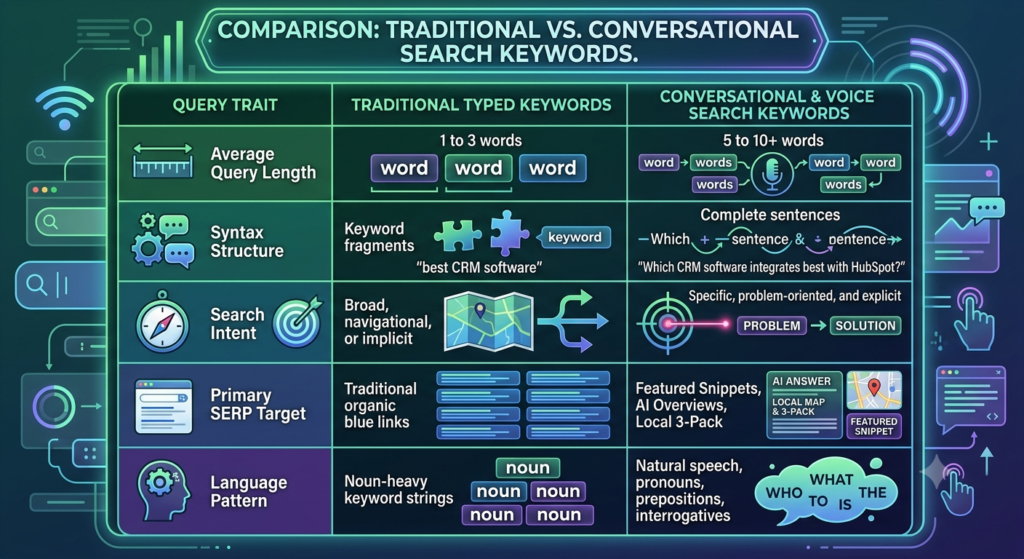
The Structural Shift: Text vs. Voice Queries
Voice search queries are structurally longer, highly contextual, and overwhelmingly question-driven compared to traditional typed inputs. When typing, users minimize physical effort by entering root terms like “SEO strategy.” When speaking into a smartphone, smart display, or wearable, users naturally express complete ideas utilizing question words (Who, What, Where, When, Why, How) and localized modifiers.
Step-by-Step Tutorial: Voice Search Keyword Research Strategy
Voice search keyword research relies on mining real-world natural language data to isolate high-intent long-tail questions before competitors map them. Execute this multi-tool research framework to extract actionable, question-based conversational keywords.
1. Mine Conversational Question Wheels with AnswerThePublic
AnswerThePublic aggregates search queries directly from search engines and categorizes them into interrogative branches based on prepositions and question stems. It provides an immediate visual map of every Who, What, Where, When, Why, and How variation users search for around your seed topic.
Execution Workflow:
- Input Seed Terms: Enter a primary 2-word topic into AnswerThePublic (e.g., “content marketing”). Set your exact target market and language.
- Isolate Question Hubs: Navigate directly to the Questions visual wheel. Prioritize the How, What, and Why clusters, as these reflect high informational and commercial research intent.
- Export and Filter: Download the raw query dataset. Remove generic navigational terms, filtering specifically for long-tail queries containing 5+ words.
- Group by Intent: Cluster similar questions together into master themes. For example, group “How to measure content marketing ROI” and “What is a good content marketing ROI” under one primary content section.
2. Map Intent Trees and Follow-Up Questions with AlsoAsked
AlsoAsked mines real-time People Also Ask (PAA) data to visualize the exact logical sequence of follow-up questions users ask after their initial search. This unveils the exact hierarchy needed to build comprehensive, answer-first content structures.
Execution Workflow:
- Enter High-Value Questions: Paste a primary long-tail question discovered in Step 1 (e.g., “How does voice search impact SEO?”).
- Analyze Multi-Level Trees: Examine the generated node graph. Level 1 nodes reveal immediate follow-up questions, while Level 2 and Level 3 nodes highlight deeper technical edge cases and sub-topics.
- Build Content Outlines: Use Level 1 nodes as primary ## Heading 2 titles and Level 2 nodes as supporting ### Heading 3 subsections. This structure ensures your content covers the full context required by AI ranking algorithms.
3. Extract Real-Time Spoken Variations via Google Autosuggest & Search Modifiers
Google Autosuggest and native People Also Ask accordions reflect high-velocity search queries typed and spoken by active users. Utilizing search wildcards and question modifiers reveals exact-match spoken search strings.
Execution Workflow:
- Deploy Search Wildcards: Type question prefixes combined with an asterisk (*) into the Google search bar (e.g., “how to optimize for voice search on *” or “why is my * not ranking”).
- Expand PAA Accordions: Perform a search for your primary question keyword and expand 3 to 4 People Also Ask accordions. Google dynamically loads additional related conversational queries; record every phrase that matches natural spoken patterns.
- Extract Auto-Complete Data: Use browser tools or scrapers to extract Google’s full predictive autocomplete lists directly into your master keyword repository.
4. Uncover Hidden Long-Tail Queries in Google Search Console
Google Search Console (GSC) stores historical performance data for low-volume, highly specific conversational queries that traditional keyword tools miss entirely. Finding queries with high impressions but low click-through rates (CTR) unlocks immediate quick-win optimization opportunities.
Execution Workflow:
- Apply Question Regex Filters: Navigate to Performance > Search Results > Queries. Insert a Custom (Regex) filter matching common spoken starters: (?i)\b(who|what|where|when|why|how|is|can|does|should|will)\b.
- Sort by Impression Volume: Filter results to show queries ranking on positions 5 through 20 with substantial impression volume.
- Identify Content Gaps: Pinpoint long-tail questions where your domain ranks on page 2 but lacks a dedicated, concise answer block in an H2 or lead paragraph.
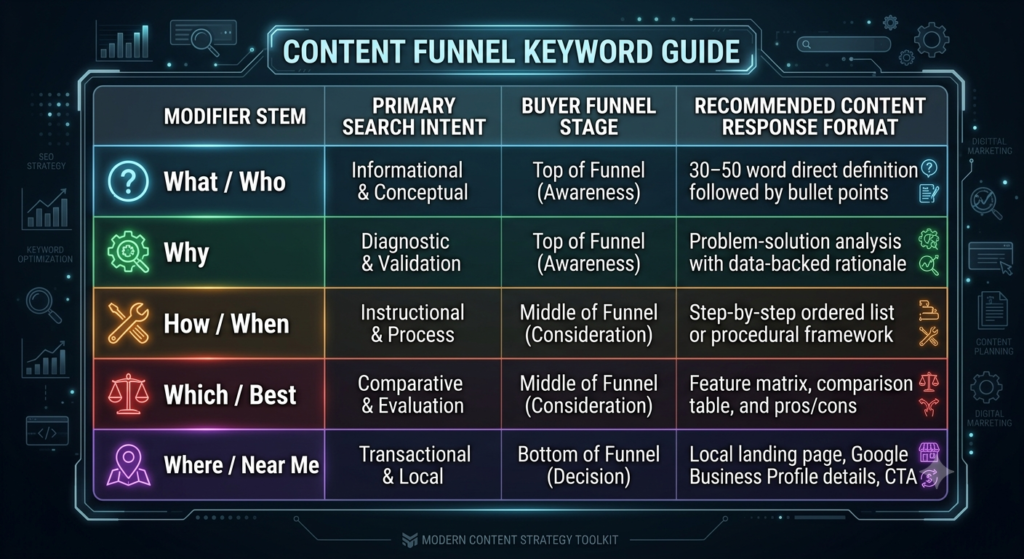
Mapping Question Modifiers to Funnel Intent
Question modifiers indicate buyer readiness and dictate the specific format your content answer must take. Categorizing conversational keywords by intent prevents misaligned messaging and maximizes engagement across the search funnel.
Integrating Conversational Keywords into Content Strategy
Structuring content around conversational keywords requires satisfying search engines and voice assistants within the first 50 words of every section. Placing concise, direct answers immediately below headings maximizes your eligibility for Featured Snippets and AI-driven summaries.
1. Apply the Inverted Pyramid Model for Answer Blocks
Lead every major section with a 30 to 50 word summary sentence that directly answers the heading query before providing detailed supporting context. Smart devices extract these concise lead sentences to speak answers aloud to users.
- Fluff-Heavy Intro (Avoid): “Voice search has been growing rapidly over the past few years, and many digital marketers wonder how to optimize for it properly…”
- Inverted Pyramid Answer (Recommended): Optimize for voice search by targeting long-tail question keywords, placing concise 30-to-50-word direct answers immediately under H2 headers, structuring data with FAQ schema, and maintaining page load speeds under 2 seconds.”
2. Implement FAQ Page Structured Data (JSON-LD)
FAQ Page Schema (FAQPage) explicitly defines question-and-answer pairs for search engine crawlers in a structured JSON-LD format. Adding structured markup eliminates ambiguity when AI models parse your page content.
JSON
{
  "@context": "https://schema.org",
  "@type": "FAQPage",
  "mainEntity": [{
    "@type": "Question",
    "name": "How do you do voice search keyword research?",
    "acceptedAnswer": {
      "@type": "Answer",
      "text": "Perform voice search keyword research by extracting question-based long-tail keywords from AnswerThePublic and AlsoAsked, filtering Google Search Console data with interrogative regex queries, and identifying natural spoken phrasing in Google's People Also Ask trees."
    }
  }]
}
3. Adopt Active Voice and Entity-Rich Phrasing
Conversational copy must read naturally when spoken aloud while maintaining technical authority. Write using active voice, concise sentence structures, and explicit named entities rather than ambiguous pronouns.
- Vague Passive Phrasing: “When these keywords are used in content, it gets picked up better by assistants.”
- Direct Entity-Rich Copy: “Integrating conversational keywords into H2 headings allows Google Assistant and Siri to parse exact-match answer blocks efficiently.”
Tracking and Measuring Voice Search ROI
Voice search traffic does not pass a distinct “voice” referrer tag in standard analytics platforms, requiring proxy metrics to evaluate performance. Track Featured Snippet ownership, long-tail impression growth, and local query rankings to evaluate your conversational keyword strategy.
- Featured Snippet Ownership: Monitor rankings for target question keywords using tools like Ahrefs or SEMrush. Position 0 ownership directly correlates with being selected as the spoken answer on Google Assistant and Google Home devices.
- Long-Tail Query Impression Growth: Track total impression volume in GSC for queries containing 5 or more words. Upward impression trends confirm your content matches expanding natural language search patterns.
- Local Conversational Traffic: Measure click growth on transactional queries containing “near me” or localized intent modifiers in Google Search Console and Google Business Profile Insights.
Summary Action Plan for Content Marketers
- Prioritize Long-Tail Questions: Focus research efforts on 5+ word phrases starting with Who, What, Where, When, Why, and How.
- Combine Research Tools: Use AnswerThePublic for query breadth, AlsoAsked for intent hierarchy, and GSC regex for hidden internal data.
- Format for Instant Extraction: Place direct 30-to-50-word summary answers immediately under every sub-heading.
- Deploy Schema Markup: Implement JSON-LD FAQ schema across all high-value instructional and commercial pages.