

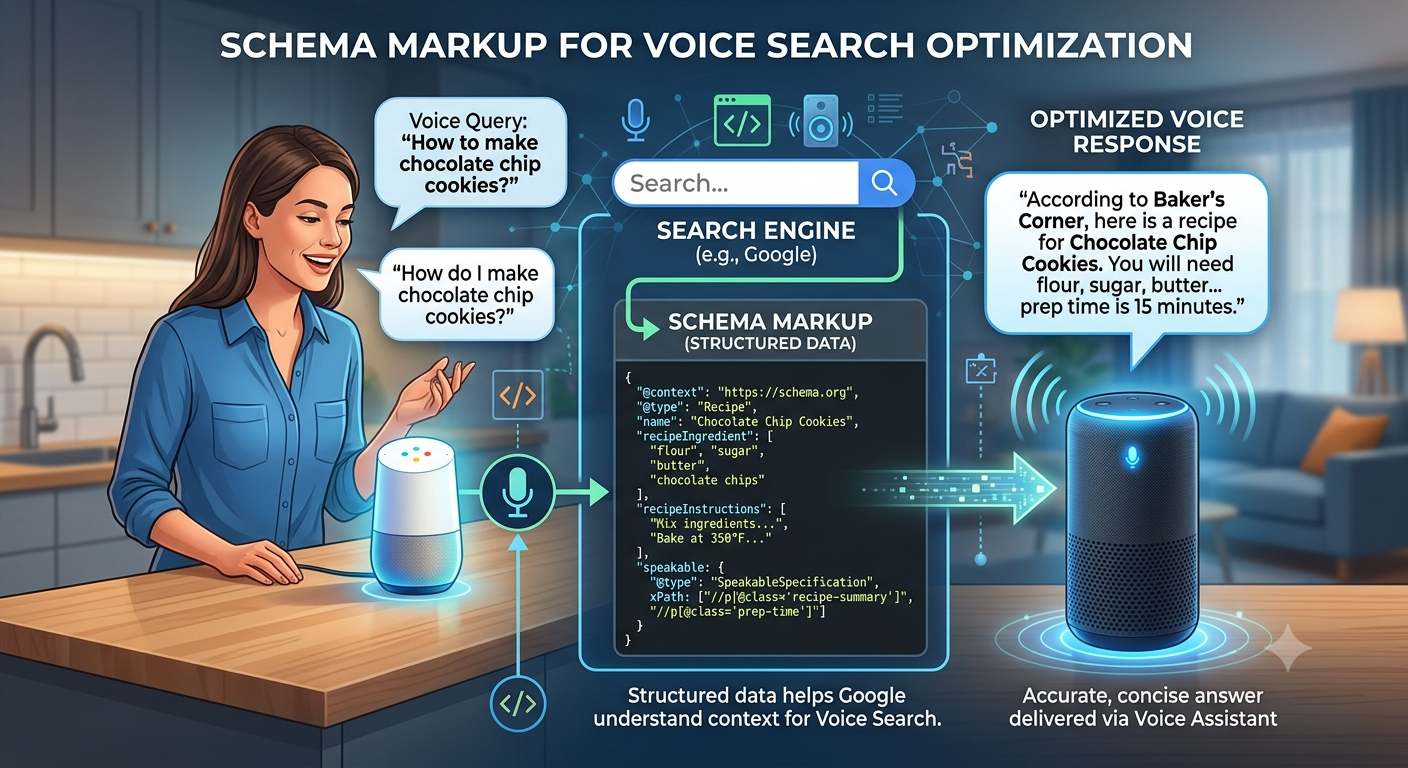
The way people search has fundamentally shifted. Gone are the days when users relied solely on typing fragmented keywords like “best Italian restaurant near me” into a desktop browser. Today, thanks to the explosion of smartphones, smart speakers, and voice assistants like Siri, Alexa, and Google Assistant, users speak to their devices using natural, conversational language: “Hey Google, where is the closest authentic Italian restaurant open right now?”
This evolution from typed keywords to spoken questions has massive implications for how search engines understand and display content. To capture this lucrative and rapidly growing traffic, website owners can no longer rely on traditional SEO alone. You need to speak the language of search engines, and the most fluent dialect available is Structured Data and Schema Markup.
In this comprehensive guide, we will break down everything you need to know to leverage structured data for voice search optimization, driving your content straight to the coveted “Position Zero” and voice assistant readouts.
1. The Voice Search Revolution: Why Traditional SEO Is Not Enough
To understand why schema markup is the secret weapon of voice search, we first need to look at how voice search behaves differently compared to traditional text search.
Text Search vs. Voice Search
- Text Search: Typically short, concise, and keyword-focused (e.g., “weather New York”). The search engine provides a results page (SERP) with ten blue links, allowing the user to browse, compare, and click at their own leisure.
- Voice Search: Long-tail, conversational, and question-based (e.g., “What should I pack for a trip to New York this weekend?”). Because voice assistants usually have small screens or no screens at all, they do not read a list of ten links. Instead, they provide one single answer—often sourced directly from a featured snippet.
The Role of Search Engines as Direct Answer Providers
When a user asks a voice assistant a question, the assistant acts as a curator. It scours the web for the absolute most accurate, authoritative, and cleanly formatted answer. If your content isn’t structured in a way that machines can effortlessly parse, verify, and understand, your site will be bypassed entirely—even if your article is brilliantly written.
This is where Schema Markup comes in. It acts as a translator, turning human-readable content into machine-readable data.
2. Demystifying Structured Data and Schema Markup
Before diving into optimization tactics, let’s establish clear definitions for the core terminology.
What Is Structured Data?
Structured data is a standardized format for providing information about a page and classifying the page content. It uses a specific code structure so that automated crawlers (like Googlebot) can easily comprehend what the data represents.
What Is Schema Markup?
Schema markup is the specific vocabulary or code (created collaboratively by Google, Microsoft, Yahoo, and Yandex at Schema.org) that you add to your website’s HTML. If structured data is the concept, schema markup is the actual language you write it in.
Popular Formats: JSON-LD vs. Microdata
Search engines accept a few different formats for structured data, but the industry gold standard is JSON-LD (JavaScript Object Notation for Linked Data).
- JSON-LD: Injected into the header or body of your HTML as a script block. It keeps your underlying webpage code clean and is heavily favored and recommended by Google.
- Microdata: Nested directly within your HTML tags. It can bloat your code and makes maintenance a headache.
Pro Tip: Always use JSON-LD for your schema implementation unless you have a very specific technical constraint requiring otherwise.
3. How Schema Markup Powers Voice Search Success
Schema markup and voice search are deeply intertwined. When you implement proper schema, you are essentially handing search engines a cheat sheet about your content. Here is how that directly translates to voice search wins:
1. Feeding Featured Snippets (Position Zero)
Voice assistants heavily rely on featured snippets to answer queries. Schema markup helps search engines identify specific elements of your page—such as steps in a recipe, items in a list, or direct definitions—making it much easier for algorithms to pull your content into a snippet box.
2. Contextual Clarity and Entity Recognition
Search engines care deeply about entities (people, places, things, and concepts) and the relationships between them. Schema markup defines these entities explicitly. For example, telling a search engine that “Apple” is a corporation rather than a piece of fruit ensures your content appears for the correct user intent.
3. Local Intent and Immediate Action
A massive portion of voice searches are local (e.g., “Find a hardware store near me that is open on Sundays”). Local business schema provides precise coordinates, operating hours, and service lists, allowing voice assistants to deliver instant, actionable answers.
4. Key Schema Types Critical for Voice Optimization
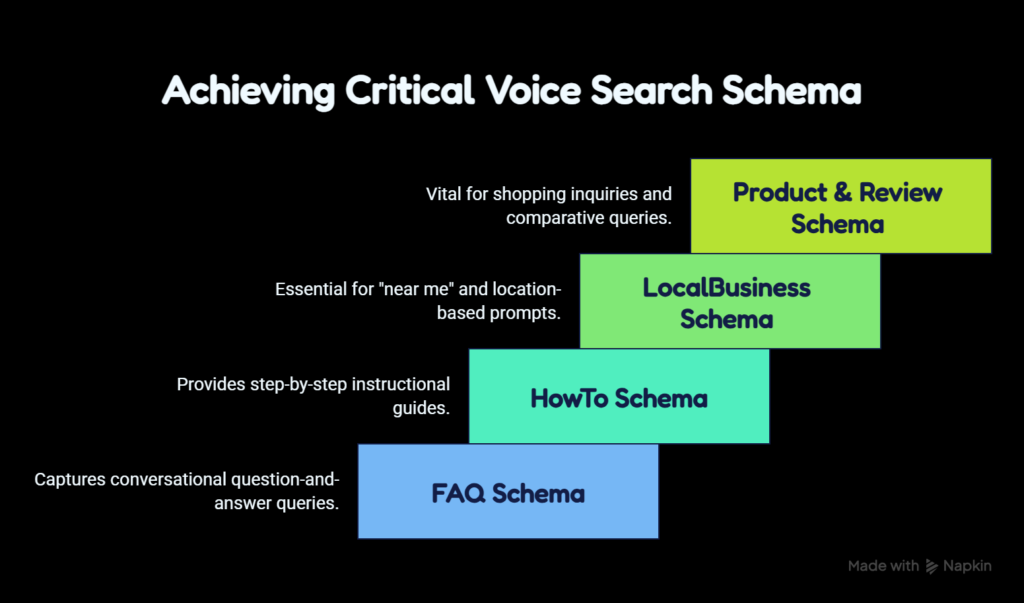
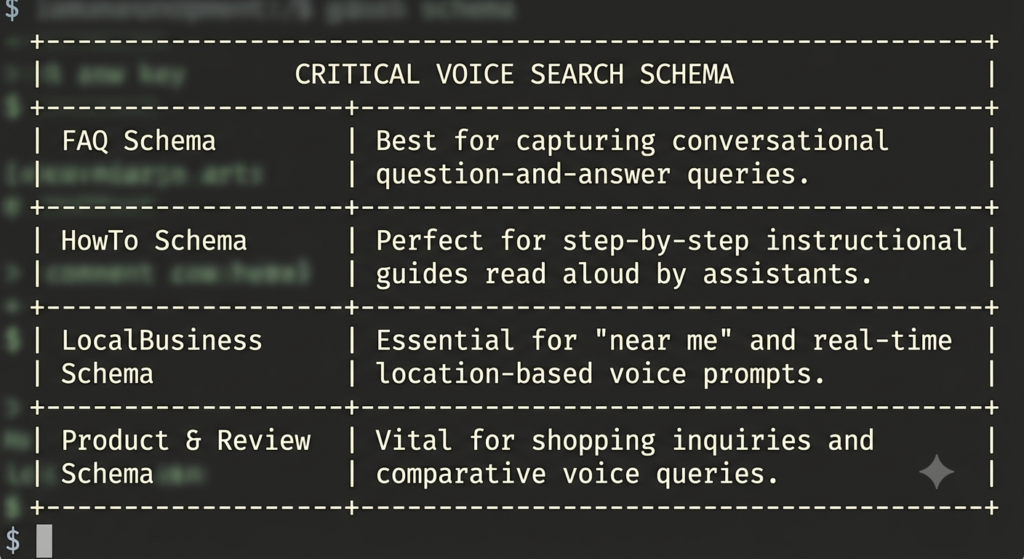
While thousands of schema types exist on Schema.org, a handful are absolute must-haves if your goal is to dominate voice search results.
FAQ (Frequently Asked Questions) Schema
Because voice queries are naturally phrased as questions, FAQ schema is one of the most powerful tools in your arsenal. By marking up your page’s questions and answers, you give voice assistants direct matching pairs to feed back to users.
HowTo Schema
If your content teaches users how to do something (e.g., “How do I unclog a kitchen sink?”), the How To schema breaks your article down into distinct chronological steps. Voice assistants can easily read these steps sequentially to the user.
Local Business Schema
For brick-and-mortar operations, local schema provides mission-critical data: name, address, phone number, geo-coordinates, operating hours, and price range. When a user asks a voice assistant for a local recommendation, local schema makes your business eligible for selection.
Product and Review Schema
Consumers frequently use voice search for product research and shopping comparisons (e.g., “What are the best-rated wireless headphones under $100?”). Product schema highlights pricing, availability, and aggregate review ratings.
5. Step-by-Step Implementation Guide
Implementing schema markup doesn’t require an advanced computer science degree. Follow this step-by-step workflow to get your site optimized:
Step 1: Identify Your Content Type
Audit your webpage and determine what category it falls under. Is it an instructional guide, a local business landing page, a product page, or an informational article with an FAQ section?
Step 2: Generate the JSON-LD Code
You can write the code manually using guidelines from Schema.org, or you can speed up the process using free online tools like Google’s Structured Data Markup Helper or JSON-LD schema generators.
Example of an FAQ Schema JSON-LD Code Block:
Step 3: Add the Code to Your Website
Paste the generated JSON-LD script block into the <head> section or right before the closing <body> tag of your webpage. If you use a Content Management System (CMS) like WordPress, plugins such as Rank Math, Yoast SEO, or Schema Pro can automate this process seamlessly.
Step 4: Validate and Test
Never skip validation. Errors in your code can prevent search engines from reading your markup entirely. Use Google’s Rich Results Test or the Schema Markup Validator to check your URLs or raw code blocks for syntax errors before publishing.
6. Advanced Strategies: Merging Conversational Content with Technical Schema
Technical markup alone won’t win the voice search game; it must be paired with a content strategy tailored to natural human speech patterns.
Optimizing for Natural Language and Long-Tail Keywords
People type differently than they speak. When typing, a user might enter “best CRM software”. When speaking, they ask, “What is the best customer relationship management software for small business sales teams?”
To capture these queries, integrate natural phrasing into your subheadings and content body. Use conversational language that directly mirrors how people talk to friends or colleagues.
Targeting “Wh- Questions” (Who, What, Where, When, Why, How)
Voice search queries are overwhelmingly dominated by question words. Structure your headings (<h2> and <h3> tags) around these exact queries.
- Instead of a heading like: “Software Comparison”
- Use a heading like: “Which CRM software offers the best value for startups?”
Crafting Concise, Direct Answers (The “Snippet Bait” Approach)
Directly beneath your question-based heading, provide a concise, 40-to-50-word summary answer. Voice assistants love crisp, straightforward definitions. Once you deliver the short answer, you can expand with deeper analysis, context, and nuance in the subsequent paragraphs.
7. Measuring Success and Monitoring Performance
Optimizing for voice search requires a shift in how you track analytics, as traditional keyword rank trackers don’t always capture voice traffic directly.
Key Metrics to Watch
- Featured Snippet Impressions and Clicks: Monitor Google Search Console for spikes in rankings where your page holds position zero. Since voice results heavily mirror featured snippets, tracking these positions is a reliable proxy for voice search performance.
- Mobile Traffic and Local Queries: Look at Google Analytics for shifts in mobile user behavior, click-to-call metrics, and map direction requests.
- Long-Tail Keyword Growth: Track impressions for multi-word, conversational query phrases in your Search Console performance reports.
Conclusion
The voice search revolution is no longer a futuristic concept—it is the modern reality of digital discovery. As reliance on voice assistants continues to accelerate, websites that fail to adapt risk becoming invisible to conversational queries.
By combining conversational, question-focused content writing with meticulous Schema Markup implementation (such as FAQ, HowTo, and Local Business data), you bridge the gap between human intent and machine understanding. Take action today: audit your key pages, implement clean JSON-LD markup, structure your answers for clarity, and position your website to be the definitive voice of authority in your niche.

