

All you need to know about Generative Engine Optimization (GEO)
1. What is Generative Engine Optimization (GEO)?
Generative Engine Optimization (GEO) is the practice of optimizing your brand’s digital content and online presence so it gets cited, referenced, and surfaced within answers generated by AI-powered search tools. It is an evolution of traditional search engine optimization tailored specifically for large language models and alternative search ecosystems like ChatGPT, Google’s AI Overviews, Perplexity, Gemini, and Claude. Instead of competing to rank at the top of a traditional page of blue links, GEO focuses on becoming a core part of the synthesized output that AI systems deliver directly to users.
2. How does GEO differ from traditional Search Engine Optimization (SEO)?
The primary difference is that SEO optimizes websites to rank high on search engine results pages to drive direct organic clicks, while GEO optimizes content to be synthesized and cited inside AI-generated answers. Traditional SEO heavily relies on exact keyword matching, technical site crawlability, and backlink authority to capture user traffic via search queries. In contrast, GEO prioritizes content clarity, semantic relevance, extractability, and authoritative third-party mentions to ensure an AI model treats your information as a trusted source for its conversational responses.
3. What is the difference between GEO and Answer Engine Optimization (AEO)?
Answer Engine Optimization (AEO) sets the foundational strategy of making content understandable to AI, whereas Generative Engine Optimization (GEO) handles the practical execution of that strategy. AEO focuses on the core concept that engines cannot surface what they do not comprehend, guiding how businesses fundamentally position information to solve a user’s problems. GEO executes this strategy by adjusting specific linguistic patterns, leveraging technical frameworks like schema, maximizing contextual depth, and managing multi-platform brand visibility to make content directly discoverable by generative tools.
4. Why is GEO becoming crucial for digital marketing?
GEO is becoming crucial because user behavior is rapidly shifting toward zero-click AI search experiences where chatbots provide immediate answers instead of a list of website links. Millions of users now utilize platforms like ChatGPT and Perplexity for product recommendations, research, and business comparisons, meaning AI systems act as digital gatekeepers for purchasing decisions. If a brand’s products or insights are not included in these synthesized summaries, they risk losing massive online visibility to competitors who are optimized for agentic search.
5. How does a generative AI engine select content to include in its responses?
Generative AI engines select content by evaluating information from across the web for intent alignment, semantic patterns, structure, and authoritative trust signals. When a user submits a prompt, the model reads and processes data from high-confidence sources like blogs, help guides, directories, and user-generated forums. It uses advanced natural language processing to identify clear formatting, direct question-and-answer phrasing, and verifiable expert consensus, weaving the most relevant slices into a single, cohesive answer.
6. What are the core strategies for optimizing content for GEO?
Effective GEO strategies center around publishing clear and relevant content, securing authoritative brand mentions, and making text highly machine-readable. This involves shifting your content creation from exact-match keywords to conversational topic clusters, using explicit names rather than generic terms, and embedding structured formatting like bullet points and definitive headings. Additionally, off-site efforts like building positive online reviews, monitoring social sentiment, and earning listings in trusted databases play an equally vital role.
7. Why is placement in highly-ranked list articles considered the most effective GEO tactic for commercial queries?
Appearing in highly-ranked comparison and list articles is vital because generative AI chatbots frequently source their commercial recommendations directly from the top organic search results on Google and Bing. Studies show that when users ask a chatbot for product or service recommendations, models like ChatGPT, Gemini, and Perplexity often synthesize or copy details almost verbatim from top-ranking comparison articles. Securing a place on these authoritative third-party lists—or publishing them on your own high-authority domain—is the most reliable way to ensure a chatbot recommends your brand.
8. How do statistics and data affect a webpage’s visibility in AI search results?
Including relevant statistics and hard data can boost a webpage’s visibility within AI-generated responses by an estimated 30% to 40%. Generative engines actively seek out verifiable, quantitative evidence to give their answers factual credibility. Publishing proprietary research, benchmark reports, or aggregate statistical data provides AI tools with the concrete details they love to extract and credit in their generated summaries.
9. What role do citations and expert quotes play in GEO?
Citations and expert quotes act as strong trust signals that encourage AI engines to extract and reference your content over unverified sources. Research indicates that adding authoritative external links to reputable studies alongside direct quotes from subject matter experts increases an AI model’s confidence in your text. This structure transforms purely qualitative copy into citation-ready paragraphs that models feel secure presenting to users.
10. How does Google’s E-E-A-T framework apply to Generative Engine Optimization?
Google’s E-E-A-T guidelines apply directly to GEO because AI models utilize these exact same signals—Experience, Expertise, Authoritativeness, and Trustworthiness—to filter out thin or unreliable content. To align with E-E-A-T for AI systems, websites must clearly demonstrate firsthand experience through detailed author bios, support their claims with credible external links, and maintain transparent business and editorial standards. High-quality content that meets these criteria is much more likely to be selected as a trustworthy source for conversational answers.
11. Why are online reviews and directories essential for chatbot recommendation algorithms?
Online reviews and reputable directories are essential because they provide the foundational reputation data that LLMs use to filter out untrustworthy businesses and order their commercial recommendations. LLMs are heavily trained on established repositories, databases, and review hubs like Wikipedia, Hoovers, G2, and Clutch. Maintaining an active profile with positive reviews (typically maintaining a score above 3.5 out of 5 stars) serves as a prerequisite for chatbot recommendation algorithms to safely suggest your brand to potential buyers.
12. What impact do user-generated content (UGC) platforms have on AI search visibility?
User-generated content (UGC) platforms have a massive impact on GEO because search engines and AI models heavily scrape these spaces to understand real-world human behavior, phrasing, and sentiment. Platforms like Reddit, YouTube, Quora, and Facebook have high exposure and weighting within generative engines. Distributing your expertise and monitoring your brand’s presence across these online communities places your messaging directly within the active data pools that AI search tools use to formulate detailed answers.
13. How does website structure and clarity influence an AI engine’s ability to extract information?
A clear, modular website structure is vital because AI engines do not read web pages like humans; they extract specific, bite-sized textual chunks to formulate their answers. Content should be organized into short, focused sections of 75 to 300 words that answer distinct questions, utilizing descriptive subheadings formatted as actual queries. If an article’s layout is chaotic or relies on vague marketing fluff, the AI model will struggle to parse the context and will likely bypass the page entirely.
14. Why is schema markup considered a high-impact element for GEO?
Schema markup is a high-impact element because it acts as a direct, machine-readable code blueprint that explains the exact context and meaning of your content to AI crawlers. Implementing structured data—such as FAQ, HowTo, or Product schema—removes ambiguity for search bots and language models. By explicitly labeling your information as Q&A pairs, product details, or review scores, you make it incredibly easy for generative systems to parse, categorize, and seamlessly cite your site.
15. What technical optimization factors affect how AI crawlers process content?
The most critical technical optimization factors for AI processing are server-side rendering, rapid page speed, clean HTML, and strong site crawlability. Many AI crawlers struggle to execute complex JavaScript, meaning content that relies heavily on client-side rendering may remain completely invisible to them. Ensuring your pages load quickly, are organized with an intuitive structural hierarchy, and provide a clear XML sitemap allows AI engines to index and process your content without technical friction.
16. How should page titles and summaries be written to optimize for AI Overviews?
Page titles should be unique and search-focused, while the content should lead with a concise, direct summary paragraph of 30 to 100 words. The opening of your text should answer the core question immediately in one or two clear, punchy sentences without any promotional padding. This text block can be styled as a bold intro paragraph or callout box, giving both human readers and AI crawlers an easily extractable “Key Takeaway” that perfectly fits the snippet format of Google AI Overviews.
17. What are the key metrics used to measure the success of a GEO strategy?
The key metrics for measuring GEO success include AI visibility scores, brand mention frequency, citation share, and AI share of voice. Unlike traditional SEO, which heavily monitors keyword rankings, click-through rates, and organic traffic, GEO tracks how often and how favorably your brand is referenced inside AI outputs. It measures your source attribution across various LLM platforms to verify if you are gaining authority within the agentic web.
18. What tools are currently available to track and monitor GEO performance?
Marketers can track their performance using specialized software like the Semrush AI Visibility Toolkit, Semrush Enterprise AIO, and WordPress plugins like All in One SEO (AIOSEO). These tools provide dedicated dashboards that monitor your share of voice, track prompt rankings, audit brand sentiment, and log how many times your content is cited across platforms like ChatGPT or Perplexity. They help bridge the gap between traditional search data and modern conversational search metrics.
19. Is GEO going to replace traditional SEO completely?
No, GEO is not replacing traditional SEO; it acts as a complementary layer that enhances your comprehensive search strategy. Traditional SEO remains foundational because it optimizes for standard keyword rankings and continues to drive direct, high-value organic traffic to your website. Because generative engines pull their information from the same internet crawled by traditional search engines, maintaining excellent SEO practices is actually a prerequisite for achieving strong GEO visibility.
20. What are the main risks associated with over-optimizing for Generative Engine Optimization?
The primary risk of over-optimizing for GEO is creating content tailored exclusively for AI extraction at the expense of the actual human user experience. Flooding articles with unnatural numbers of quotes, bloated statistic lists, or rigid prompt-friendly formatting can alienate real human readers and increase bounce rates. Additionally, AI visibility can fluctuate wildly as platforms update their algorithms, making it safest to anchor your strategy on high-quality, helpful, and naturally written content.
Moving from understanding what Generative Engine Optimization is (TOFU) to evaluating how it fits into your actual business strategy requires a deeper look at implementation, budgets, and measurement.
21. How do I audit my existing website content to see if it is optimized for AI search engines?
You audit your existing content by manually querying target keywords inside major AI engines to check for brand citations, followed by a technical review of your content’s structure and extractability. This process helps you map out where your brand already naturally appears and where it gets left out.
A standard GEO audit focuses on three main areas:
- Citation Mapping: Inputting 20–50 core industry prompts into ChatGPT, Perplexity, and Gemini to see which competitors are being recommended and why.
- Structural Evaluation: Reviewing your top-performing organic pages to ensure they contain concise, 75-to-300-word modular data chunks that an AI can easily scrape.
- Data Density Check: Verifying that your content contains hard statistics, unique expert quotes, and explicit schema markup rather than generic marketing fluff.
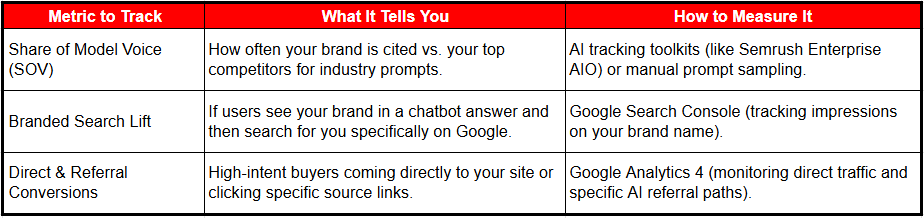
22. What is the most effective way to track and justify the ROI of a GEO campaign when AI engines don’t pass traditional click traffic?
The most effective way to justify GEO ROI is by tracking your Share of Model Voice (SOV) alongside correlated lifts in branded search volume and direct-to-site conversions. Because AI engines often summarize information without sending a user to your website, traditional traffic, metrics like click-through rates (CTR) will not tell the full story.
23. How should I restructure my digital marketing budget to accommodate GEO without hurting traditional SEO traffic?
You should reallocate roughly 15% to 20% of your current SEO content creation budget toward original data generation, digital PR, and syndication on high-authority directories. You do not need to pull money completely away from traditional SEO, as high organic rankings are actually a major prerequisite for AI engine discovery.
Instead, pivot your spending within your existing content budget. Shift funds away from writing repetitive, low-value “how-to” blog posts. Redirect those resources toward hiring subject matter experts for unique quotes, funding proprietary industry surveys, and running digital PR campaigns to secure placements on the top-ranking comparison lists that chatbots scrape for recommendations.
24. Which departments in my organization need to collaborate to build an effective GEO strategy?
An effective GEO strategy requires tight collaboration between the content marketing, technical web development, and public relations (PR) teams. Because AI engines look at both on-site data structures and off-site brand reputation, this cannot be treated as a siloed marketing task.
The Collaborative Workflow:
- Content Marketing writes the structured, data-heavy text and interviews internal experts.
- Technical Development ensures the site uses advanced schema markup and maintains clean, server-side rendered HTML that AI bots can easily crawl.
- Public Relations handles off-site visibility, ensuring the brand is mentioned favorably on third-party forums, industry directories, and news sites.
25. How do I choose between keeping our GEO efforts in-house or hiring an external agency?
Choose an external agency if you need immediate technical schema expertise and established PR connections for third-party citations; keep it in-house if your product requires deeply specialized, technical subject-matter expertise that an outside writer cannot easily replicate.
If your team already excels at creating high-quality, authoritative content, you likely only need an agency for a one-time technical audit and setup (such as configuring advanced JSON-LD schema). However, if your team struggles with digital PR and securing mentions on top-tier industry blogs, an agency’s existing media relationships can significantly speed up your AI citation wins.
26. What is a realistic timeline for seeing measurable results from a newly launched GEO strategy?
You can generally expect to see initial shifts in AI engine citations within 3 to 6 months of launching a GEO strategy. This timeline is heavily dependent on how frequently specific AI engines refresh their training data or update their real-time search indexes.
- 1 to 2 Months (Fast Track): Real-time search tools like Perplexity or Google’s AI Overviews can pick up newly optimized, highly authoritative on-site content within days or weeks of crawling it.
- 3 to 6 Months (Core Models): Static, foundational models (like standard ChatGPT or Claude) may take several months to incorporate your brand into their broader knowledge bases, usually occurring during major model fine-tuning cycles or database refreshes.
27. How can B2B software companies optimize their product documentation specifically for AI search engines?
B2B companies optimize documentation for AI by converting complex user guides into clean, modular Markdown files with explicit Q&A sections and robust product schema. Software buyers frequently ask chatbots technical questions like “How do I integrate Product X with Product Y?” or “Does Product X support SAML authentication?”
To win these queries, structure your documentation pages with clear, descriptive headers formatted exactly like user questions. Avoid burying technical details inside downloadable PDFs or behind login walls, as AI crawlers need open, un-gated text to pull specifications and code snippets directly into their answers.
28. What are the primary warning signs that a brand’s online reputation is causing AI engines to ignore or downrank them?
The biggest warning signs are a cluster of unaddressed negative reviews on major directories, a total lack of third-party citations on trusted industry blogs, and negative sentiment trends across user-generated forums like Reddit. Because LLMs are trained to mimic human consensus, they look at aggregate public opinion to determine if a brand is safe to recommend.
If an AI engine consistently responds to queries with statements like “While Brand X is popular, users frequently report issues with customer service,” it means the model has ingested negative sentiment from review sites. If this happens, your GEO efforts must temporarily pivot away from content creation and focus entirely on reputation management and resolving public customer complaints.
29. How do I adapt my brand guidelines so that AI engines maintain a consistent brand tone when answering queries about my company?
You adapt your brand guidelines for AI by publishing a public-facing, highly structured “About Us” or digital press kit page that uses explicit, unambiguous language to define your company’s positioning, category, and core values. AI engines do not understand subtle marketing metaphors or poetic brand speak; they look for definitive declarations.
Instead of writing a vague line like “We disrupt the digital workspace ecosystem,” your brand page should explicitly state: “We are a B2B project management software platform designed specifically for remote engineering teams.” Providing clear, factual anchor text ensures that when an AI system synthesizes information about your company, it categorizes your business accurately and uses the correct industry terminology.
30. Should my team prioritize optimizing for Google AI Overviews or platforms like ChatGPT and Perplexity first?
Prioritize Google AI Overviews if your business relies heavily on local foot traffic, immediate e-commerce sales, or broad transactional queries; focus on ChatGPT and Perplexity if your audience consists of tech-forward researchers, complex B2B buyers, or long-form informational searches.
Ideally, you want to target both, but their technical mechanisms differ slightly. Google AI Overviews are tightly bound to traditional Google search rankings and location data, making classic technical SEO a top priority. ChatGPT and Perplexity rely more on conversational synthesis across web-wide discussions, user forums, and independent review sites, making digital PR and forum visibility the quicker win for those platforms.

)