



Competing in agentic commerce changes what organic search is for. It’s no longer just a way to get low-cost traffic. It becomes the checkpoint AI systems use to verify whether your brand, product, and claims are credible.
That means you can’t rely on clever marketing tactics or growth hacks anymore. The shortcuts stop working. What actually matters is whether your product does what you say it does — and whether the web consistently reflects that truth.
This week, we’re breaking down:
- Why agentic commerce sidelines brands built on marketing spin and favors those with deep, structured product data.
How ChatGPT, Copilot, and Google’s emerging protocols are changing merchant margins, visibility, and direct customer relationships.
- What to optimize first — from product feeds to technical protocols — and the rollout order that actually makes a difference.
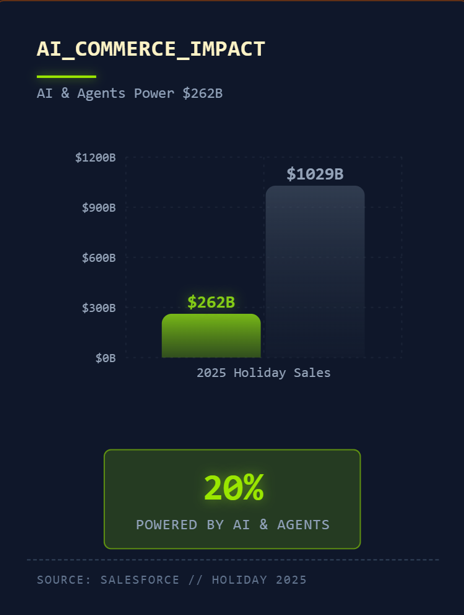
Agentic commerce is becoming a kind of “great filter” for marketing arbitrage. Organic search is no longer just a low-cost traffic channel — it’s turning into the verification layer AI systems rely on before recommending or transacting with a brand.
The shift is already happening. During the 2025 holiday season, AI-driven agents influenced roughly 20% of retail sales. Even if that figure includes broad definitions, the takeaway is clear: agentic commerce is no longer theoretical. It’s here.
All the major LLM platforms have moved into direct commerce:
- ChatGPT now supports Instant Checkout through Shopify and Etsy, along with its Agentic Commerce Protocol (ACP).
- Microsoft Copilot integrates ACP and enables Copilot Checkout via PayPal, Shopify, and Stripe.
- Google has built checkout directly into AI Mode and Gemini through its Universal Commerce Protocol (UCP).
The infrastructure layer is no longer a question — it’s already in place.
What remains is the strategic challenge of competing in agentic commerce when customers can purchase without ever visiting your website.
Table of Contents
Toggle1. Agentic Commerce Has a Missing Middle
- Understanding this is critical for competing in agentic commerce effectively. Fully autonomous purchasing — where you hand an AI your credit card and let it shop freely — isn’t about to become mainstream.
- At the high end, purchases like flights or cars are too personal and too expensive to delegate. People have specific preferences — seat selection rules, loyalty programs, trim packages, financing terms — that are difficult for any agent to model with confidence.
- At the low end, everyday essentials like paper towels or detergent are already automated through subscriptions and recurring delivery programs. Adding an AI agent doesn’t meaningfully improve that experience.
So the real opportunity isn’t at the extremes. If expensive purchases resist delegation and cheap ones are already automated, the true impact zone is narrower than the hype suggests.
- A more accurate framing is conversational commerce. Instead of fully automating the purchase, LLMs dramatically compress the research and decision-making process.
- They synthesize expert reviews, product specifications, ingredient lists, and user feedback directly in the interface — rather than relying on keyword bids or historical conversion signals. This is the real operating model for competing in agentic commerce.
- The real shift isn’t handing over your wallet. It’s collapsing what used to take 14 clicks into one or two.
2. Protocols Make E-commerce “Headless.”
The new commerce protocols let AI agents connect directly to your backend systems instead of crawling your website and ranking you in a list of links. In effect, commerce becomes “headless” — the customer interface is separated from your underlying infrastructure.
These infrastructure shifts redefine how brands approach competing in agentic commerce.
This changes the rules:
- Your website matters less as a destination and more as a structured data source.
- The focus shifts from designing landing pages for humans to structuring clean, reliable data feeds for machines.
- If your shipping times, inventory levels, pricing, or return policies aren’t accessible via API, agents simply can’t see you.
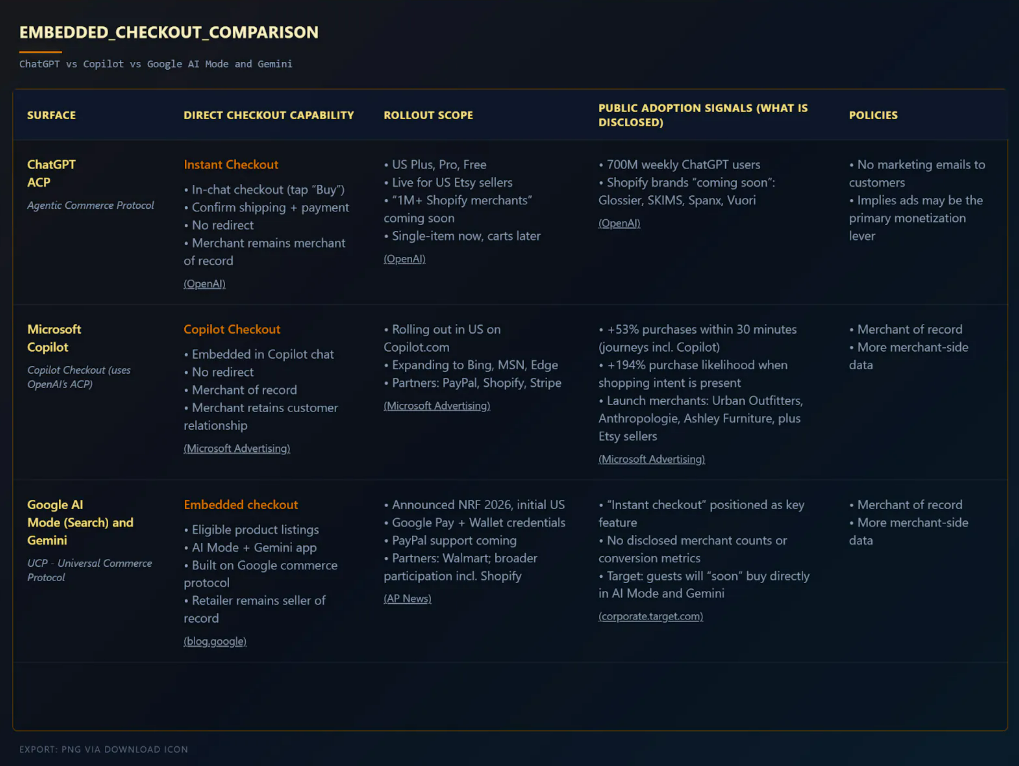
Moving from crawling to protocols also compresses the traditional funnel. What used to be search → browse → compare → click → checkout becomes two steps:
(1) The model interprets intent and matches it to expert signals and real-time inventory data, and
(2) The user completes the purchase in a single click with stored credentials.
Read This Also: Humans Still Matter: Why AI Alone Isn’t Enough to Win at SEO.
OpenAI’s ACP (Agentic Commerce Protocol)
- The Vision: A Walled Garden
OpenAI’s model keeps the entire transaction inside the chat interface. From the user’s perspective, discovery, comparison, and checkout all happen in one place. In this setup, merchants function more like suppliers plugged into OpenAI’s ecosystem than independent storefronts.
- The Trade-off: Reach vs. Lifetime Value
The upside is distribution — access to hundreds of millions of weekly users. The downside is ownership. If customer data (like email addresses) isn’t shared for marketing, you lose the ability to run post-purchase flows, cross-sell campaigns, and retention programs. That means sacrificing the 15–20% of lifetime value that typically comes from remarketing and repeat engagement.
Google’s UCP (Universal Commerce Protocol)
- The Vision: A Distributed Transaction Layer
Google is extending its Shopping Graph into a commerce layer that sits across Search, Lens, and Gemini. Rather than containing the entire experience in a single interface, it connects transactions to Google’s broader ecosystem.
- The Trade-off: Ownership vs. Competition Intensity
Unlike ACP, Google allows merchants to retain the customer relationship — including email capture and loyalty data. You keep lifecycle control. But competition becomes fiercer. Instead of competing for ten blue links, you’re competing for one of a handful of AI Overview placements. With fewer visible slots, the tolerance for weak product data, slow feeds, or incomplete attributes drops to nearly zero.
Choosing between these models is a core decision in competing in agentic commerce.
To know about Advantages and Disadvantages, Read This: Advantages and Disadvantages of Social Media : Guide.
3. Conversational Commerce Disrupts the Entire Ecosystem
The move from search-driven browsing to conversation-led buying reshapes who wins, who loses, and where the leverage sits.
For buyers, the experience improves dramatically.
- Discovery becomes curated.
Instead of clicking through multiple product listing ads for something like running shoes, users get distilled recommendations informed by expert reviews, specs, and real customer feedback.
Cognitive load drops.
Agentic commerce changes what organic search is for. It’s no longer just a way to get low-cost traffic. It becomes the checkpoint AI systems use to verify whether your brand, product, and claims are credible.
The model does the heavy lifting — research, comparison, filtering — shrinking what used to be a 14-click journey into one or two guided interactions.
For merchants, the trade-off is distribution versus control.
On ChatGPT:
You gain access to a high-intent, early-adopter audience, but you give up ownership of the customer relationship. No email capture, no remarketing leverage, and limited influence over commissions or recommendation logic.
On Google or Copilot:
You remain the merchant of record and retain lifecycle data. But as the funnel compresses and fewer clicks happen on-site, traditional ad inventory loses value. Conversion rates may increase — yet total ad revenue can decline as the interface absorbs more of the journey.
Affiliates Struggle When the Click Disappears
- The trap: If LLMs summarize reviews and recommendations without sending traffic back to publishers, the incentive to create independent review content weakens. Over time, fewer humans write original analysis, and models risk training on recycled AI-generated summaries — a self-reinforcing loop.
- The pivot: To survive, publishers may need to shift models — putting premium research behind paywalls, licensing content to platforms, or charging merchants directly for in-depth reviews and testing.
Content economics are being rewritten for anyone competing in agentic commerce.
Amazon Faces a Structural Tension
- The conflict: Amazon’s retail margins are razor-thin (around 1%). The real profit engine is advertising — a business worth tens of billions annually.
- The risk: That ad business depends on a multi-step browsing funnel filled with sponsored placements. If conversational commerce reduces the journey to a single interaction, much of that sponsored inventory disappears.
- The choice: Amazon can restrict crawler access to protect its ad model — or integrate more fully into conversational systems and risk cannibalizing it. Moves by competitors like Walmart to partner with AI platforms increase the pressure to decide.
Google May Be Best Positioned
4. SEO Shifts From Optimizing Clicks to Optimizing Ingestion
- Monetization parity:
Google is already integrating ads into AI Overviews and reporting comparable monetization to traditional search in many cases.
- The economics:
As AI improves relevance, conversion rates can rise sharply. Even if total clicks decline, advertisers may be willing to pay more per click to reach higher-intent buyers — potentially keeping the system economically balanced.
We’re moving from a world of nearly infinite shelf space — ten blue links and endless pagination — to one with extreme scarcity: maybe three recommendation slots inside an AI response.
In that environment, SEO is no longer about earning the click. It’s about earning inclusion. The objective isn’t to drive a user to your landing page; it’s to ensure your product data enters the model’s context window with enough clarity, completeness, and authority to be selected.
- The new technical SEO looks different.
In the old model, “feed quality” meant fast load times, mobile optimization, and strong Core Web Vitals. In the protocol era, technical SEO becomes about feed integrity.
Agents don’t browse your site. They query your APIs.
Your website shifts from being a designed destination to being a structured data layer. The merchants who win will treat their product feed — not their homepage — as their true storefront.
The New “On-Page SEO”: From Content Volume to Information Gain
Traditional SEO often rewarded content that repackaged existing consensus to rank for broad keywords. But LLMs are already trained on that consensus. Repeating it adds no value.
To be cited now, your content has to deliver Information Gain — the measurable difference between what the model already knows and the new, verifiable insight you contribute.
- Specs beat slogans.
You can’t market your way past weaker product fundamentals. If you claim to be the “best running shoe for flat feet,” the model won’t care about adjectives. It will compare your arch support data, materials, and test results against established standards in its training data.
- Shift from engagement to “Product Truth.”
Content needs to become structured, testable, and specific. Detailed comparison tables, proprietary testing (“we drop-tested this phone 50 times”), ingredient transparency, and quantified performance data matter more than persuasive copy. If your information isn’t structured for easy ingestion and validation, the model will default to a source that is.
The New “Off-Page SEO”: From Link Juice to Reputation Synthesis
Backlinks still matter — but not primarily as a ranking signal. Their role shifts toward verification.
- Third-party consensus is critical.
LLMs aggregate signals from forums, review platforms, expert sites, and communities like Reddit. A high volume of specific, credible, third-party reviews becomes one of the strongest trust signals you can generate.
- Brand becomes the tie-breaker.
When an AI presents only two or three recommendations, familiarity carries weight. Brand advertising and long-term brand building regain importance — not just for awareness, but to ensure users recognize and trust the option the AI suggests.
5. The End of “Marketing Brands.”
Over the last decade, many white-label brands grew by arbitrating attention — buying ads, optimizing funnels, and using branding to justify premium pricing on commoditized products. Agentic commerce challenges that model.
LLMs don’t respond to slick positioning. They evaluate structured data. If a “premium” product has the same materials, specs, and performance metrics as a generic equivalent, the model has little reason to recommend it at a higher price.
The move to protocol-driven commerce also creates a paradox: AI systems can interpret long-tail, highly specific intent with precision — but often fulfill that intent using well-known, high-authority inventory.
- Safety Bias: Models lean toward consensus to minimize the risk of hallucination. A dominant, widely cited brand appears stable and trustworthy. A niche brand can look like statistical noise.
- The RAG Effect: Retrieval-augmented systems typically pull from the top 10–20 search results. Because search engines already privilege authority and established players, RAG pipelines often reinforce incumbents rather than surface challengers.
Granular data is the only thing that can break this bias toward incumbents. Your merchant feed makes the claim — what your product is, what it does, how it performs. RAG becomes the trust layer, cross-checking that claim against the broader web.
The result is a split market:
- Incumbents win broad, general support because they benefit from consensus. Their scale and citation volume signal safety and reliability.
- Specialists win narrow, high-constraint intent through depth and specificity — but only if they surface in top search results where retrieval systems actually look.
If you publish data the major players overlook — precise sourcing details, lab analysis, quantified performance metrics — the model may be forced to select you when a user’s query includes those constraints. But that only happens if your content ranks high enough to be retrieved in the first place.
Organic search is no longer about driving traffic. It’s the qualification layer that determines who succeeds in competing in agentic commerce.
Lorem ipsum dolor sit amet, consectetur adipiscing elit. Ut elit tellus, luctus nec ullamcorper mattis, pulvinar dapibus leo.